

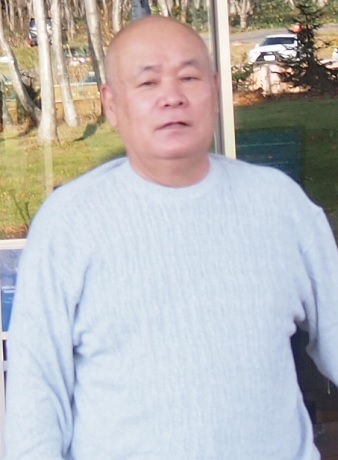
A long time has passed since I left Kamuro, and somewhere, the part of me that I have pushed out of oblivion lurks. Sometimes, as time passes, memories of my childhood suddenly come back to me. So, what was I doing? I lived in Okikamuro for 15 years after I was born, until I graduated from junior high school. From 1951, while I was still crossing the sea on the Seto Maru, the population of the island gradually decreased, and Okikamuro Junior High School became Towa Junior High School, and the following year, junior high school students disappeared from the school. I wonder what our ancestors were thinking as they lived their lives. They did their best to survive in the moment, but they must have also dreamed of the future.
From then on, I returned home every year for Obon and at the end of the year, twice a year for how many years. After graduating from high school and getting a job, my visits became less and less frequent, down to once a year at most. I tried my best to look after my parents while they were alive, but as the subtitles say, my elderly father and mother lived out their lives in Okikamuro, but in the end they died at Hakujuen and Towa Hospital... I was able to survive three eras, Taisho, Showa, and Heisei, but I was unable to live my life to the fullest in Okikamuro, where I was born, and I no longer ate the air of Kamuro. (I never felt the atmosphere when I was born.)
During the 15 years I lived in Okikamuro, it was truly poor (bottomless poverty). Looking back, I think the whole of Okikamuro was in a similar state. The population decline could not be stopped by the passage of time, and a vicious cycle continued. The island's water problems, drawing water from a communal well, and well water droughts were a daily occurrence. It seemed as if people were refusing to live in Okikamuro (I think the disparity between rich and poor households is largely related to the private well). The food source was relayed on only little arable land and rainwater. Wheat and sweet potatoes were the main crops. Fish was caught that day (unavailable if storms continued). It was a time when hunger and poverty were rampant throughout Okikamuro.
What were our ancestors thinking as they lived through the difficulties of raising children in Kamuro? I am no longer living in Kamuro, but I attend the Kanasai(Osaka) Kamuro Party meeting, which is held every year. Due to the effects of COVID-19, the event was not held for two or three years, but in 2023, it was held for the first time in a long while and was very lively. I hope that everyone will do their best in this era of 100-year lifespans. Starting this year, the organizers will be a little younger, and they will be what we call young people in Kamuro. I hope that the Kansai(Osaka) Kamuro Party meeting will continue to play its role not only as a group that reminisces about my hometown, Oki Kamuro, but also as a group that thinks about living in Kamuro and the prosperity of Kamuro.
Proposal: Development of Okikamuro
In response to the difficulty in obtaining Kamuro hijiki (hijiki farming), consider farming Kamuro wakame, Kamuro hijiki, etc. (Farming trials in Okikamuro)
1. Issues with fishing rights (Can farming be a business in Okikamuro?)
2. Consider whether it will contribute to the prosperity of the people living in Kamuro.
3. Secure a source of income for Okikamuro (capital participation by the Osaka Kamuro Party [each regional Kamuro Party]).
4. No compensation is required for capital participation.
5. Business reports are required for capital participation
6. Products will be sold at a low price to Kamuro Association members (prices will be differentiated from other sales).
7. Other...
When it comes to aquaculture businesses, we want to avoid huge amounts of capital without thinking too much about it.
First, we need to do what Okikamuro can do on its own. We need to use the sea of Okikamuro without causing any inconvenience to fishermen. I think there is less risk of negligence in hijiki farming than in wakame farming. We will confirm and consider the current state of the sea and land before investing. All businesses should be considered as a source of income for young people living in Okikamuro. By supporting the current residents of Kamuro, we hope that we will be able to pursue the dreams of our ancestors, and that one day we will visit our hometown as a source of hope to live until they are 100 years old. If only we could talk about how to make Okikamuro a historic town that has connected 400 years of history, prosper... The fields and mountains of my hometown have become barren and desolate at some point.
The magnificent terraced fields cultivated by our ancestors can now only be seen in old photographs. The sky-high terraced fields were created with the limited water resources (rainfall) on the small island of Okikamuro, and it seems they were created with an explosive population growth. At the same time, people also emigrated overseas to work overseas (including deep-sea fishing), and many left Okikamuro. They were forced to do so because they couldn't make a living. I think this is a by-product of a money-driven society, but I think it was because they couldn't make a living in Okikamuro. The times are moving incredibly fast, and will likely continue to move faster. However, food is essential for human survival.
As far as I know, all seafood from Okikamuro is different and wonderful. (The same goes for barley miso.) If you grow up in Kamuro, the air and flavor of Kamuro are in a way that is far more delicious than anywhere else. I, my children, grandchildren, great-grandchildren, and so on all have Okikamuro in our DNA, and we all carry that DNA with us. We are people who understand the flavor of Kamuro, the good DNA emitted from Okikamuro. We are DNA that needs the flavor of Kamuro. (We are buyers and purchasers of Okikamuro by-products.) Okikamuro by-products will be needed in large quantities. (Maintaining and expanding business is in our DNA)
Regarding hijiki farming, does Okikamuro's topography lend itself to maximum expansion with minimal investment?
I think that hijiki farming requires trial and error. Wakame farming can only be successful if the wakame bacteria are attached to the seaweed, but hijiki can be cultivated by cutting the actual seaweed into 5cm pieces and clamping them between ropes, which I think dramatically increases the probability of success. Okikamuro is blessed with a good environment and there are places to set up the plants. As for costs, I think it would be fine to start small with about 1,000 yen per person at the annual Kamuro meeting in each district. The only costs would be the floating rope on the sea and the large container needed to stretch it. The cost to start a trial would be enough, but what is most needed is whether there are any current Okikamuro residents who are willing to start it.
If the whole island doesn't come together, the business won't expand. Without the support of securing a location (fishing rights issue), there's no point in talking about it, so it's essential that the whole island participates as one. We Okikamuro people grew up in a fishing town, and the fisherman's mentality is deeply rooted in us. This has both positive and negative implications. It's like when farmers started disputes over water. Our predecessors started many businesses in Okikamuro, but I think the fisherman's mentality got in the way, which is why they all came to nothing. If we can start small with an eye to the future, it would be a good thing to use this opportunity to talk about our dream of achieving annual sales of 300 million yen (including related products)?
The mountains, fields, sea and even houses of my hometown are in ruins. What can I do now? The mountains and sea protected by my ancestors are a place where the people who live in Okikamuro now, and those who will live in the future, can pursue their dreams. I hope to live on an island of dreams where I can become a living Okikamuro and a living Okikamuro person. Surely this would not be allowed on ‘the island of peaceful deaths’ that was published a long time ago? I was able to die peacefully on a beautiful island of dreams. I think this would leave a better testimony of my life.
Copyright kamuro partyAll Rights Reserved.